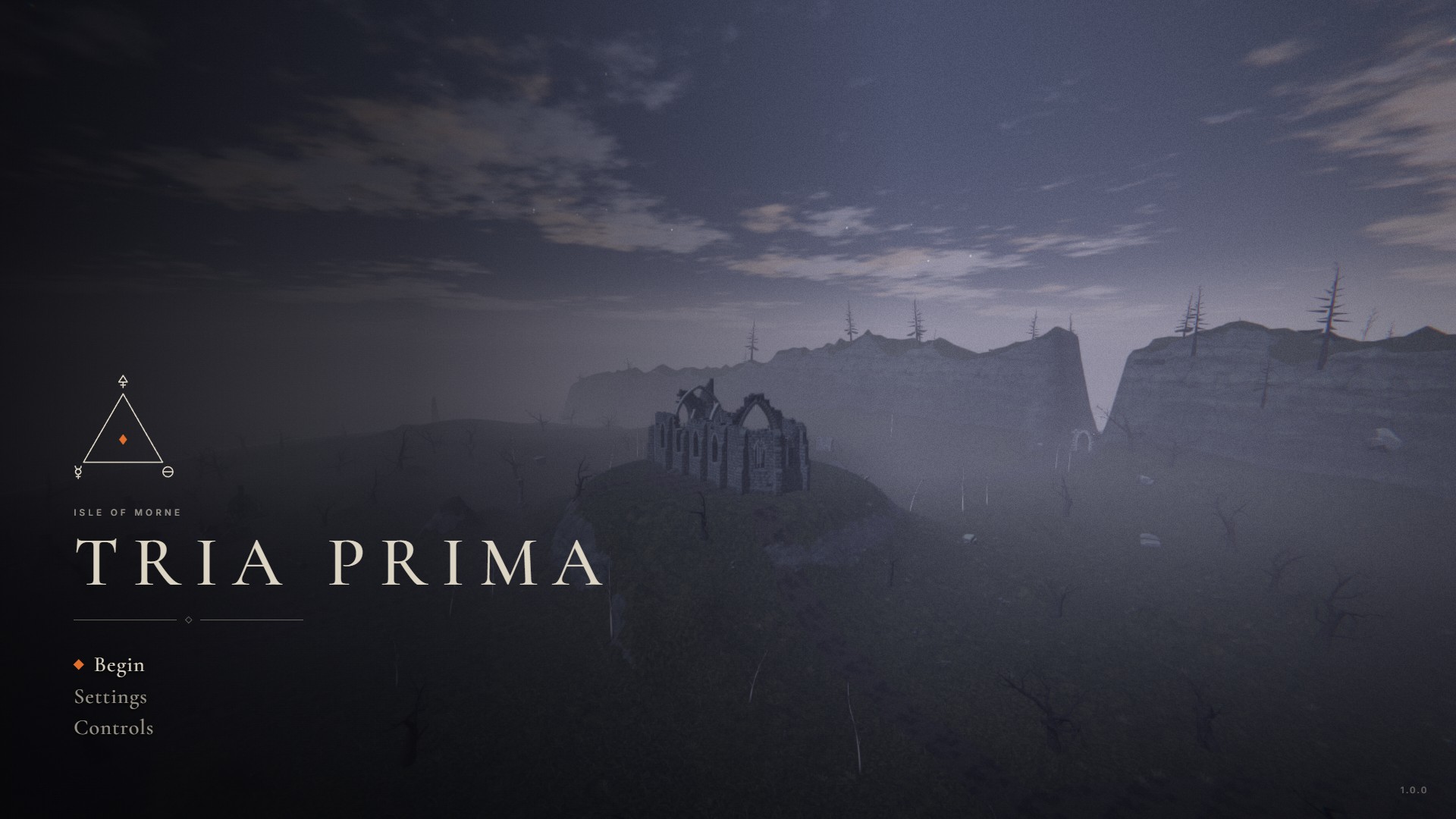
What Tria Prima is
The Athanor, the furnace that kept the Isle of Morne alive, has gone cold. The Gloom has come up out of the ground and the isle is dying under it. You are the last apprentice. Gather what still grows, brew it in the ruined chapel, and use what you brew to reach the three Primes — Salt, Mercury and Sulfur — that lie where the Gloom is thickest. Unite them in the Great Work, make the Stone, relight the fire.
Tria Prima is a dark-fantasy alchemy adventure in first person, played in the browser. It needs a keyboard, a mouse and WebGL 2, and a full run takes about an hour. Every model, texture and sound on the isle is generated in code — there are no asset files — which is why the whole thing weighs what a single screenshot used to.
How to play Tria Prima
Press play at the top of this page. The author's public GitHub Pages build loads in the embedded player.
- Explore. Nine ingredients grow, crust and smoulder in their own corners of the isle, and the Gloom hunts in the low places.
- Brew. Every mixture is a point inside a triangle whose corners are Sulfur, Mercury and Salt. Each ingredient pulls the mixture toward itself. Each of the seven potions owns a region of the triangle and a heat band: put the mark inside the region, bring the fire into the band with bellows and damper, stir until it binds, bottle it.
- Throw. Each potion is a verb that changes the world, and each one opens new ground. Ember burns briar and lights the lanterns of the dead. Verdance wakes a seed into a vine you can climb. Rime lays ice on water and crust on lava. Levity lifts what is heavy. Fulminate breaks cracked stone. Saltspire raises a pillar to stand on. Aqua Vitae mends you.
- Survive the Gloom. Shades hunt in it. Fire unmakes them, cold holds them still, and a lit lantern is somewhere to come back to.
The loop is explore, gather, brew, throw — and each new verb opens new ground and new ingredients. That is a real design, not a demo loop: by the time you are standing at the Grey Landing with a full bandolier, you are playing a game about chemistry that never once uses the word chemistry.
What is in it
- A first-person island with heightmap terrain, water, grass and weather, all generated in code.
- Seven potions, each a world-changing verb with its own region, heat band and physics.
- A brewing chart you can actually read: the triangle is the UI, and the ingredients are points in it.
- A book — journal, chart, herbal, and the pages you find — on
Tab. - Shades, lanterns, and a Gloom that is a place rather than a texture.
- Photo mode on
P, because of course there is.
Who made it, and what did the AI do
Tria Prima was made by winch — the same maker as REGOLITH — and the repository publishes the design and module contracts in the maker's own words: what the isle is, how the chart works, where every number lives. What the maker has not published is a round-by-round account of what the AI did on this game, and per the rules of this wall we do not invent one. The design documents are linked from the source, which is MIT-licensed and linked here with the maker's name and source preserved; the playable build remains on the author's public GitHub Pages site.
Where it sits on the wall
It shares its stamp with REGOLITH: same maker, same tool, one a lunar survey sim and the other a dark-fantasy alchemy adventure. Two genres, one stamp. The tool is not the style; the person still is.